Why exterior paint fails in East Texas, and what actually prevents it
Almost everything that fails on an exterior repaint failed at prep, usually years before the coating gave up.
September 6, 2026 · 4 min read
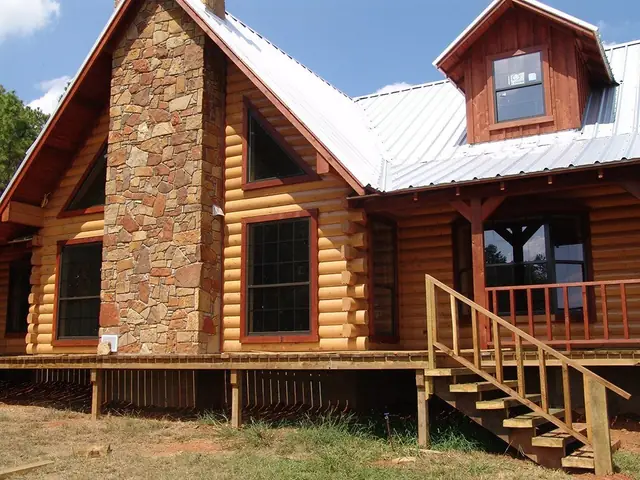
If you have owned a house around Lufkin for more than a few years, you have probably watched an exterior paint job go from fine to obviously tired faster than you expected. The usual reaction is to blame the paint. Occasionally that is fair. Far more often, the coating did exactly what it was going to do given the surface it was put onto, and the real decision that shortened its life was made before anybody opened a can.
Humidity is the variable the label does not account for
Manufacturer data sheets are written for a set of conditions, and East Texas spends a lot of the year outside them. Our humidity keeps siding, trim and masonry damper for longer than a drying window assumes, and it slows the point at which a surface is genuinely ready for the next coat rather than just dry to the touch.
That matters because paint does not simply sit on a wall, it bonds to it. Moisture trapped underneath a coating has to go somewhere, and the direction it goes is outward, pushing against the film. Add a summer where a south-facing wall heats up sharply in the afternoon and you have the conditions that lift paint away from the substrate.
The three failures you will actually see
Blistering shows up as bubbles under the film, often on the sunniest elevation. It is almost always moisture or a surface that was not properly dry when it was coated. The bubbles are the coating being pushed off a surface it never fully gripped.
Chalking is the powdery residue you find on your hand after running it down a wall. Some chalking is normal weathering. Heavy chalking means the binder in the coating has broken down, and if a new coat goes straight over the top of it, the new coat is bonding to loose powder rather than to the wall.
Peeling at joints, seams and end grain is the third. Water gets into a gap, the timber behind it moves, and the coating loses its grip in a strip rather than a patch. This one is worth taking seriously quickly, because by the time paint is peeling at a joint, the wood underneath is usually already taking water.
What good preparation actually looks like
Prep is unglamorous, invisible in photographs, and the single largest factor in how long the job lasts. On a typical East Texas exterior it means most of the following.
- Washing the surface properly so that chalk, dirt, pollen and mildew are removed rather than painted over.
- Scraping and sanding back any coating that is no longer bonded, and feathering the edges so the repair does not telegraph through.
- Letting the surface genuinely dry rather than working to a schedule that assumes it has.
- Filling and caulking joints, seams and gaps so water has nowhere to sit behind the film.
- Priming bare substrate, and spot-priming anywhere the old coating was removed down to the material.
- Treating end grain and cut edges, which are where exterior timber drinks the most water.
Repaint or patch?
A patch is reasonable when the failure is genuinely local: one elevation that takes weather the others do not, a section of trim that was replaced, a run of fascia under a gutter that was leaking. If the surrounding coating is sound and well bonded, there is no sense recoating the whole house.
Repaint when the failure is general. If several elevations are chalking, if you can find loose coating in more than a few places, or if the color has drifted enough that a patch would never blend, patching becomes an expensive way to postpone the real job by a season. Repainting also gives you the chance to correct the substrate problems that caused the failure, which patching mostly does not.
Questions worth asking before anybody starts
- What is the actual condition of the existing coating, and how did you check rather than assume?
- How much of this quote is preparation, and what specifically does that preparation include?
- What will you do about the joints, seams and end grain, not just the flat surfaces?
- Is anything being primed, and if so, which parts and why those parts?
- What happens if the surface is not dry enough on the day you planned to coat it?
The answer to that last one tells you a great deal. A contractor who says the schedule moves is telling you the truth about how coatings behave here. Ace Paint Contracting has been painting around Lufkin and East Texas since 1988, and the reason our older jobs still look the way they do is not a secret product. It is that the wall underneath was ready before anything went on it.
Ace Paint Contracting, (936) 637-0557
Call (936) 637-0557More articles
Drywall finish levels: how to spec the right one for your room
The right level of finish is decided by the light in the room and what is going on the wall, not by habit.
Painting a school, church or clinic that cannot close
The scheduling is part of the trade, not an inconvenience attached to it.