Service 02
Drywall finishing
Surface finishing, mudding, taping, floating and texturing, for residential and commercial rooms alike. Free digital estimates available.
Chapter 01
The level of finish your room actually needs
Drywall finishing is not one standard. A warehouse wall that will take a heavy texture and a flat coating does not need the same treatment as a living room wall that will be painted in an eggshell and lit from the side by a window all afternoon.
The difference matters because of light. A smooth wall under raking light shows every seam, every fastener, every ridge left by a knife that was worked too fast. A room with softer light and a texture over the top hides a great deal. Deciding how far to take the finish before anyone opens a paint can is the cheapest decision on the whole job, and the most expensive one to get wrong.
So we ask what the room is for, where the light comes from, and what is going on the wall afterwards. Then we finish it to that, rather than to a habit.
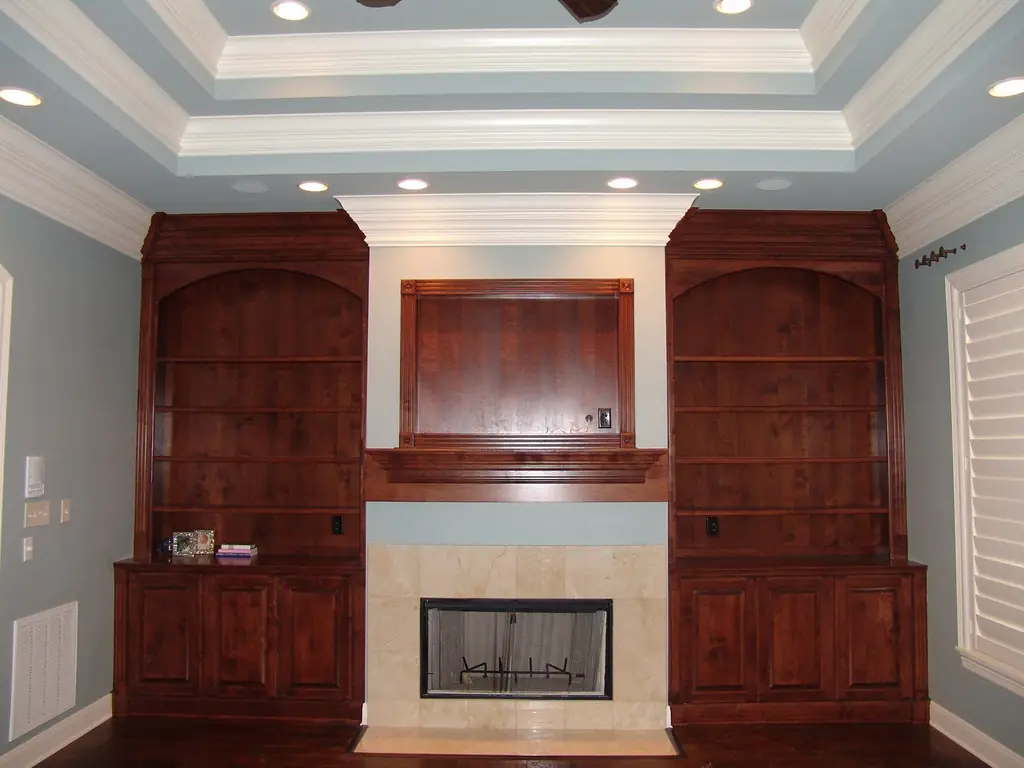
A residential living room with a painted trey ceiling and stained built-in bookshelves either side of the fireplace
Tape, mud, float, texture, and the drying discipline between them
The order is not negotiable and neither is the waiting. Tape sets the joint. Mud fills and builds it. Floating feathers the compound out wide enough that the eye cannot find the transition. Texture, where it is called for, goes over the top of all of it.
What separates a good finish from a bad one is mostly patience between those steps. Compound that is coated over before it has properly dried will shrink underneath and crack later, and in East Texas humidity that drying takes longer than most schedules assume. Sanding a joint that is not fully cured tears it rather than smoothing it.
There is no way to compress that honestly. A crew that rushes the drying is buying itself a callback and buying the owner a wall that cracks in the second year.
Chapter 03
Matching an existing texture so the repair disappears
Repair work is the hardest drywall finishing there is, because the target already exists on the wall next to you. A knockdown, an orange peel, a hand-troweled finish and a stipple all read differently, and within each of those there is a spread rate and a knife pressure that whoever did it originally used without writing it down.
Getting a patch to disappear means reading the surrounding wall, mixing to that consistency, and testing on a board rather than on the customer's ceiling. It usually also means feathering the repair out further than the damaged area strictly required, because the eye finds a hard boundary between two textures far more easily than it finds a gradual one.
Done properly, nobody can point at where the hole was. That is the whole standard for the job.
Ace Paint, OSHA-certified trainer on staff. Call (936) 637-0557.