Painting a school, church or clinic that cannot close
The scheduling is part of the trade, not an inconvenience attached to it.
September 6, 2026 · 3 min read
If you manage a school, a church, a clinic or a government office, you already know the constraint that makes your painting project different from a house: the building does not stop. Congregations still meet, patients still arrive, terms still start on the date printed months ago. The work has to fit around the building's calendar rather than the other way around.
What is less obvious is that this changes the technical decisions too, not only the schedule. A painting plan for an occupied building is a different plan, and treating it as the same job with different hours is where these projects go wrong.
Sequencing is the actual deliverable
The first conversation worth having is not about color. It is about which spaces can come out of service, for how long, and in what order. A corridor that has to stay open constrains everything around it. A wing that can be closed for two weeks in July is worth more to the project than twice that time in October.
Good sequencing also means being honest about the dependencies. Ceilings before walls before trim, and floors protected throughout, because reversing that order means the finished surface below gets damaged by the work above it. When somebody promises to do it in a different order to suit the calendar, ask what they are giving up.
Odor and cure time stop being a footnote
In an empty house, a coating that takes a while to cure and smells while it does is a minor issue. In a clinic with patients in the next room, or a classroom that has to be occupied on Monday morning, it becomes one of the main selection criteria for the product.
That pushes a lot of occupied-building work toward water-based products, which have improved enormously and are right for most interior wall fields anyway. It also means the difference between dry to the touch and genuinely cured matters, because a room handed back too early gets marked up by the first cart that touches it.
Dust control and containment
Preparation makes dust. In an empty building that is a cleanup task at the end. In an occupied one it is a containment problem from the start, because the dust does not respect the line you drew on the floor plan.
- Sealing the work area rather than roping it off, so that sanding does not migrate down the corridor.
- Protecting the surfaces that stay in use, including floors that other trades and the public will keep walking on.
- Planning where materials are stored so that a public route is not also a storage area.
- Cleaning down at the end of each shift rather than at the end of the project, because the building has to look usable tomorrow.
Finishes chosen for how the building is really used
Institutional buildings take contact that homes do not. Door frames get gripped hundreds of times a day. Corridor walls take carts, cases and bags. Gym walls take balls and bodies. Restroom walls get cleaned with something considerably stronger than water, over and over, for years.
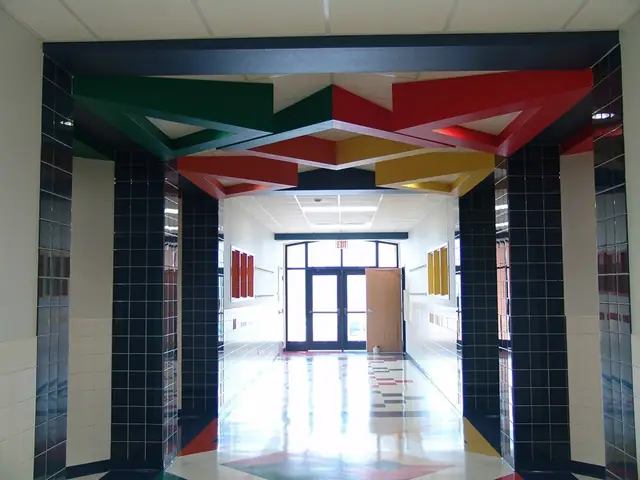
So the specification changes surface by surface. An enamel that can be wiped down belongs on the beam at an entrance and the frame around a door, even where a flat coating is right for the ceiling either side of it. Concrete block gets block filler before a finish coat, because block drinks paint and telegraphs its texture through anything thin. And on walls where cleaning is constant, vinyl wallcovering often outlasts any paint, because it is designed to take the abrasion instead of the wall taking it.
Safety in a building full of people
Working at height in a room that the public can walk into is a different risk picture from working at height on a construction site. Access equipment has to be managed around people who are not part of the project and are not looking out for it, which affects when certain work can happen at all.
This is worth asking about directly, because it is where corners are quietly cut. Ace Paint Contracting keeps an OSHA-certified trainer on staff, so safety training happens in-house rather than being bought in once a year.
We have been painting occupied buildings across East Texas since 1988, including churches, schools, medical facilities, LEED-certified projects, restored historical buildings, multi-family facilities, and state and federal government buildings. If you have a building with a calendar it has to keep, tell us the calendar first and we will build the plan around it.
Ace Paint Contracting, (936) 637-0557
Call (936) 637-0557More articles
Why exterior paint fails in East Texas, and what actually prevents it
Almost everything that fails on an exterior repaint failed at prep, usually years before the coating gave up.
Drywall finish levels: how to spec the right one for your room
The right level of finish is decided by the light in the room and what is going on the wall, not by habit.