Vinyl wallcovering or paint: choosing for a wall that gets cleaned
When the cleaning schedule is the thing destroying your wall, the answer is not a better paint.
September 6, 2026 · 3 min read
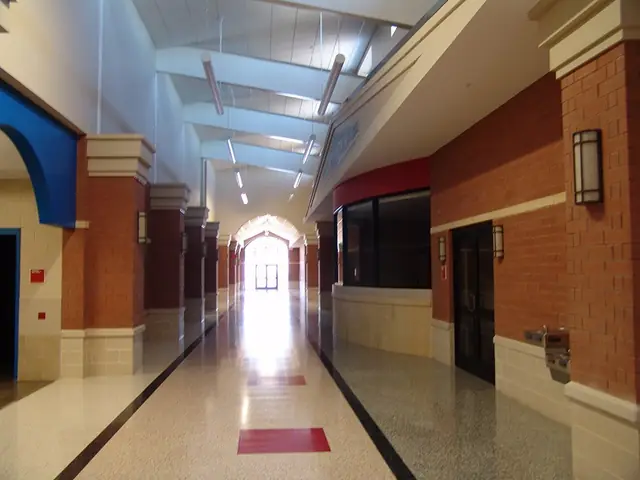
Paint is the right answer for most walls in most buildings. It is flexible, it is repairable, it costs less to install, and it can be changed when somebody decides the color is dated. None of that is in dispute. The question worth asking is narrower: what about the walls where paint keeps failing no matter how good the job was?
The specific case where paint loses
Think about a restroom in a school, a corridor in a hotel, or the wall behind a drinks station in a convenience store. These surfaces get cleaned with something stronger than water, repeatedly, for years. That is not abuse, it is the building being maintained properly.
A painted finish in that position starts to burnish where the cloth goes. The sheen changes in patches, then the film thins, and eventually the cleaning itself becomes the thing wearing out the wall. You end up on a repainting cycle driven not by fashion or damage but by hygiene.
Vinyl wallcovering is a physical sheet with a wearing surface built for exactly that treatment. It takes the abrasion so the substrate does not. The same logic applies to impact: in a corridor taking carts and cases every day, vinyl absorbs knocks that would chip a painted block wall into a maintenance ticket.
Where moisture comes into it
Moisture is the other half of the decision. Rooms that are regularly humid put a coating under constant stress, and over time that shows up as adhesion problems long before the color looks tired. A wallcovering specified for those conditions handles the environment as a design condition rather than as an exception to be survived.
What vinyl demands in return
Vinyl is unforgiving about what is underneath it, and this is the part that gets underestimated. It will not hide a defect the way a textured paint finish can. Every ridge, every unfilled joint and every piece of loose material telegraphs straight through the sheet, and once the adhesive is on, going back is expensive.
- The wall has to be brought flat and sound first, not simply cleaned.
- It has to be primed with something the adhesive will bond to rather than release from later.
- Existing coatings have to be assessed honestly, because hanging new vinyl over a surface that is quietly failing means both layers come off together.
- Seams have to be planned to fall where the eye does not travel and where the room's own lines already break, not wherever the roll ran out.
That last point is worth dwelling on. In a corridor, seam layout means reading the doors, the lighting and the sightline from the end of the run before the first drop goes up. Seams placed by convenience are the difference between a wall that reads as a surface and one that reads as a series of panels.
The five-year question
The honest way to compare the two is not to compare installation costs. It is to ask what the wall costs to own over five years, including the disruption of doing the work again in an occupied building.
For a low-traffic office wall, paint wins that comparison easily. For a restroom that gets cleaned daily, the arithmetic often reverses, because the repainting cycle is short, and every cycle means taking the room out of service again.
Repair behaves differently too. When damage happens, and in a busy building it eventually does, a damaged section of vinyl can be cut out and replaced rather than the whole wall being recoated. That is one reason it is worth keeping the run and batch details from the original installation somewhere you can find them later.
How to decide
Ask three questions about the specific wall, not about the building as a whole. How often does it get cleaned, and with what? Does it take physical contact from people, carts or equipment? And what does it cost, in disruption rather than dollars, to take that room out of service to redo it?
If the answers are rarely, not much, and not very much, paint it. If they are daily, constantly, and a great deal, that is the wall vinyl was designed for. Most buildings have some of each, which is why the useful specification is usually a mix rather than one decision applied everywhere.
Ace Paint Contracting hangs vinyl wallcovering in bathrooms, hotels, churches, convenience stores and schools around East Texas, and paints everything else. If you are not sure which side of the line a particular wall falls on, that is a short conversation and worth having before the work is specified.
Ace Paint Contracting, (936) 637-0557
Call (936) 637-0557More articles
Why exterior paint fails in East Texas, and what actually prevents it
Almost everything that fails on an exterior repaint failed at prep, usually years before the coating gave up.
Drywall finish levels: how to spec the right one for your room
The right level of finish is decided by the light in the room and what is going on the wall, not by habit.